
Origin & ingredients · Uganda
Uganda brings together distinctive growing regions and the craft of careful harvesting, curing and fermentation. For coffee roasters, chocolate makers and food producers, that combination creates the potential for ingredients with real character.
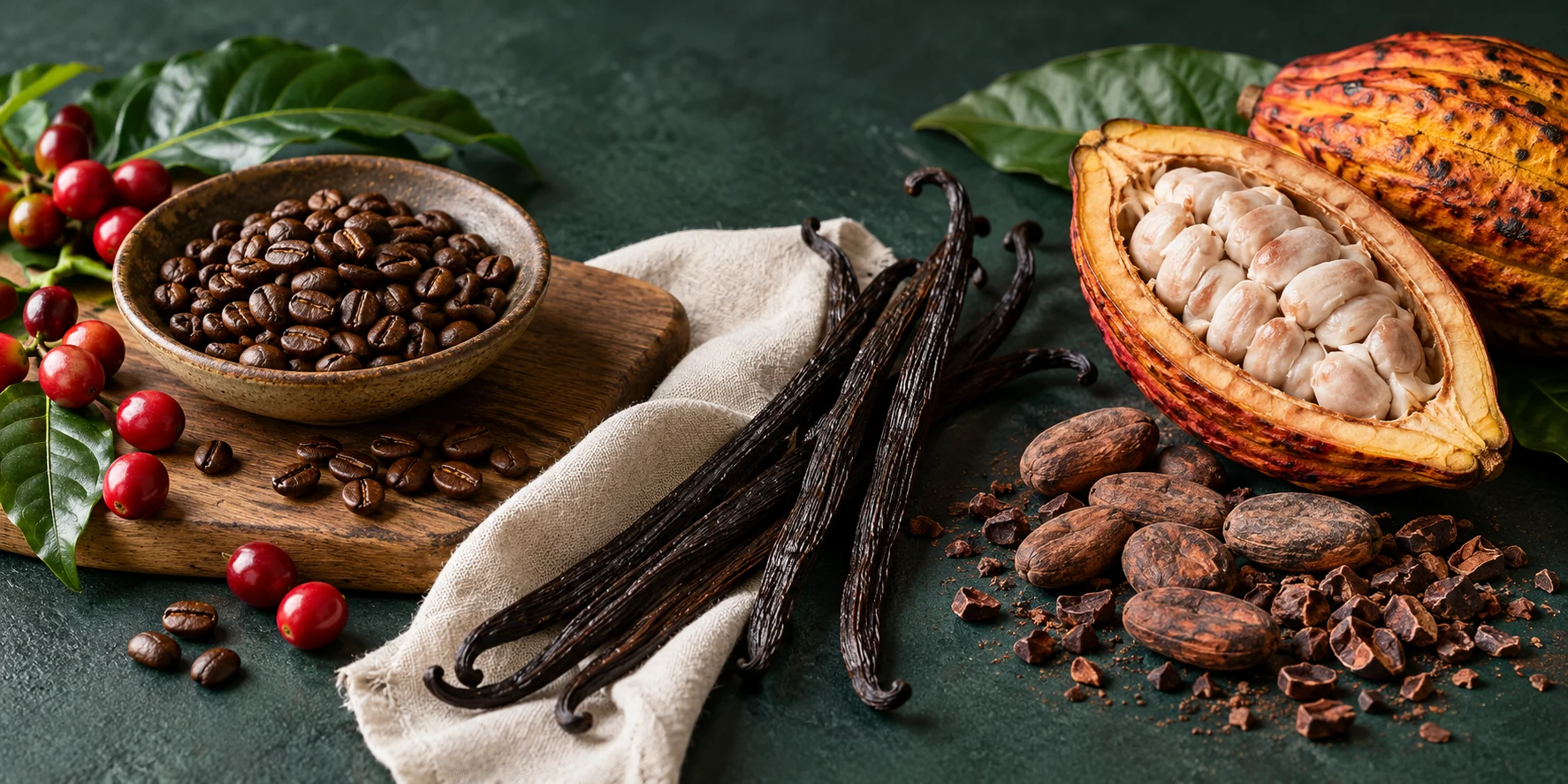
Exceptional quality begins with the growing environment and is developed through the work that follows harvest. Origin is a useful starting point; the finished lot, its flavour and its documented specification determine whether an ingredient is right for your product.
Coffee: altitude, origin and a distinctive cup
Uganda produces both Arabica and Robusta. Its highland Arabica regions include Mount Elgon and the Rwenzori mountains, while Robusta is grown across lower elevations. These different environments give buyers a broad starting point for selecting coffee to match an espresso blend, filter roast or other application.[1]
In suitable highland environments, cooler growing conditions and fertile soils support the development of complex coffee profiles. Uganda’s coffee authority highlights the combination of elevation, temperatures and rich volcanic soils in Mount Elgon’s growing environment. Robusta also has a long local heritage: it is native to Uganda’s Lake Victoria region, and the country’s higher-elevation Robusta can produce premium cup quality.[2] [3]
For a buyer, the next step is to evaluate a representative sample. Variety, harvest, processing method, defects, storage and roast profile all matter when defining the cup you want to reproduce.
Vanilla: mature beans and patient curing
Vanilla’s aroma develops through a demanding post-harvest process. Mature beans must be handled carefully, then cured and conditioned to bring out their aromatic potential. Ugandan producer Ndali describes a curing cycle of around three to six months, with blanching, sweating, controlled sun exposure and conditioning. During curing, glucovanillin is converted into aromatic vanillin.[4]
The balance matters. Excessive drying can leave beans brittle; inadequate drying can create mould risk. Skilled curing and sorting help produce supple, aromatic beans suited to culinary use or extraction. Ndali’s process illustrates local expertise; the specification and producer of each offered lot must be confirmed separately.
Cocoa: flavour is built through fermentation
Explore Uganda cocoa / cacao products & request a quotation →
Ripe cocoa pods provide the raw material, but fermentation is central to developing chocolate flavour potential. Microbial activity and the heat it produces trigger changes inside the beans. Controlled drying then reduces moisture while protecting the developing flavour. The International Cocoa Organization explains that drying too quickly can retain acidity, while drying too slowly can encourage mould and off-flavours.[5]
Ugandan research published in 2025 found meaningful differences between on-farm fermentation practices and the quality of the resulting beans. Recommended heap and box methods improved fermentation quality. This shows why good handling and lot selection are essential when sourcing from this origin.[6]
For chocolate makers, the value is in selecting beans with a suitable fermentation profile, clean sensory character and consistent preparation. For cocoa powder, the specification must also distinguish natural from alkalized powder and define the characteristics required for the final recipe.
Market value: strong growth, with different cycles
Ugandan coffee and cocoa recorded substantial gains during the 2025 commodity upswing. These developments describe national trade in specific periods, rather than a quotation for an individual product.
Markets also reverse. Uganda’s July 2026 coffee report recorded monthly export earnings 18.4% below July 2025, with volume down 14.9%. The earlier rise should therefore be understood as a dated growth period rather than a claim that prices keep increasing.[8]
Higher commodity prices can reflect supply shortages, weather and changes in trade volumes. A quality premium must be supported by the actual lot: its flavour, preparation, traceability and agreed specification.
Turn origin potential into a clear buying specification
A useful enquiry connects the ingredient to its intended use. Include your target market, estimated volume, delivery destination and the evidence you need to approve a sample.
| Product | Details to confirm in your RFQ |
|---|---|
| Coffee | Arabica or Robusta, growing region, crop year, processing, grade, moisture, defect limits and target cup profile. |
| Vanilla | Whole beans or paste, intended use, bean length, moisture, vanillin analysis where required, ingredients for paste and packaging. |
| Cocoa | Beans or powder, fermentation and cut-test requirements for beans; natural or alkalized powder, fat content, pH and microbiological specification as applicable. |
Request lot identification, origin documentation, a representative sample and relevant test results. Any organic, sustainability or other certification claim should be checked against a current certificate and its product scope.
Explore ingredients from Uganda
View our cocoa, coffee and vanilla programmes and send an enquiry with your specification, quantity and destination. Availability, samples, minimum order and delivery terms are confirmed for the selected product and project.
Sources & market periods
Reviewed 24 October 2026. Market comparisons refer to the periods stated above and are historical national statistics.
- CGIAR coffee farming handbook for Uganda, hosted by the European Commission’s Knowledge for Policy platform.
- Uganda Coffee Development Authority: Uganda Coffee Profiles.
- Uganda Coffee Development Authority: Robusta Coffee Handbook.
- Ndali: Vanilla Curing, a producer account of its own process.
- International Cocoa Organization: Harvesting & Post-harvest.
- Mulindwa et al. (2025): On-Farm Cocoa Fermentation Practices and Their Effect on the Quality of Cocoa Beans in Three Agroecological Zones of Uganda, NARO research repository.
- Uganda Ministry of Finance: Performance of the Economy, June 2025, merchandise exports and Table 2, May 2024–May 2025 comparison.
- Uganda Monthly Coffee Report, July 2026, July year-on-year export comparison.
- CBI: Entering the European Market for Vanilla Extract, 15 January 2026.